The way I was introduced to you was probably during the first roll call on the first day of school when you met me after the teacher says "I'm sorry if I butcher any of your names, but please correct me. Now, is there a… I'm sorry I can't pronounce this". At that time I probably raised my hand and said "Vytas, I'm here". Even though Vytautas, my full name, is a common Lithuanian name, most of you would have never heard of it if I didn't come into your life. That is ok. We Lithuanian Americans are used to this kind of behavior and have come to expect it after a few years of living in the U.S. In Lithuania, all the names are going to be difficult for you to pronounce, but there are easy ways to remember them. First of all, it is easy to identify whether someone I write about is a male or female. Almost all male names end in the letter 's' or some other consonant. Almost all female names end in vowels. If there is a 'p' in front of the name, that means "Mr" or "Mrs." For Ex: p. Simenas is Mr. Simenas, the man I am shadowing. If the female has the letter 't' in the last 2 syllables of the last name, she is a 'Ms.' If there is an 'n' within the last 2 syllables, then she is married.
There are many stereotypes about Lithuanians that have developed, as seen in this video:
Most are true, and one they did not mention is that all Lithuanians have some kind of connection to one another. For ex: My dad lived with the lead singer of that band's family in Colombia when my dad was in high school. The 'Lithuanian connection' is also how I was able to get my senior experience at the Lithuanian parliament.
Brief History of Lithuania according to an average Lithuanian: In the early 1200's, Lithuania's first and only king, Mindaugas, came into power. He united many tribes and nobles from all over Eastern Europe to make Lithuania. The unification can be compared to the American Revolution. All the states had their own powers, but George Washington can be seen as the figurehead who 'united' the colonies to fight the British. Mindaugas was the figurehead of these tribes, but Lithuania wasn't established as one country under one true ruler. The tribes were united to fight powers from the west (Teutonic knights) and east (Russia). After his death, there was a power struggle in Lithuania until Gediminas came into power in the early 1300's. Gedeminis had many kids, but two of them were Kestutis and Algirdas. They were able to expand Lithuania and they effectively fought off enemies. Kestutis had a son named Vytautas and Algirdas had a son named Jogaila. Vytautas became the grand duke of Lithuania. He ruled the brown area:
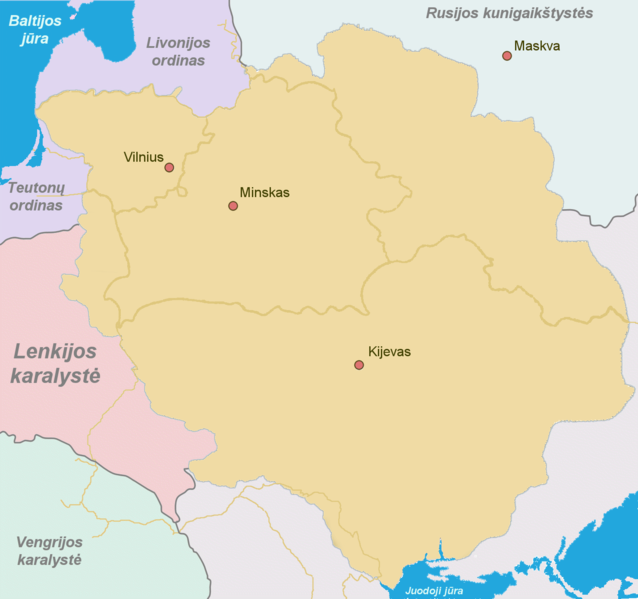
No big deal. Anyway, Vytautas was under constant attack from the Crusaders. In an effort to appease the Vatican, Vytautas was 'baptized' and made Lithuania "Catholic". He was going to be made king by the pope, but the Polish stole the crown. Vytautas was still under attack from the Crusades until 1410 in a battle called "Žalgirio Mūšis" pronounced "Zhahl-gi-dio Moo-shis". He united many of the armies in Lithuania, the Polish armies, some Mongol armies, and other armies that were under constant attack from the Crusaders. This was the last crusade against Lithuania and Vytautas emerged victorious. Jogaila, Vytautas' cousin, was rumored to have prayed in a tent during the battle. Afterward, Jogaila became powerful and united Lithuania with Poland to further fight off foreign invaders. This merger is probably seen as the single greatest act of treason in Lithuanian history.
After Vytautas, Lithuania was united with Poland and the kingdom shrunk. Eventually, The whole are was taken over by Russia in the late 1700's.Eventually under Russian rule in the 1800's, Lithuanian identity started to emerge. Even though the Russians banned Lithuanian literature, brave people known as 'knygnesiai', or 'book-carriers', ran across the border from East Prussia into Lithuania trying to give Lithuanian literature to families who home-schooled kids. Many people were killed during the process. Near the end of WWI, Lithuania declared independence from Russia on February 16, 1918. That's Lithuania's big holiday. Then, Lithuania was taken over by the Soviets. Under the Soviets, Lithuanians and other Eastern Europeans were killed by Stalin. The number killed under Stalin is said to be 3-4 times as many people than Jews that were killed under the Holocaust. During WWII, Lithuania was occasionally seized by Germany. Under German rule, some of the biggest concentration camps were in the two major Lithuanian cities, Vilnius and Kaunas. Percentage-wise, Jews suffered the most in Lithuania than in any other country other than Poland. Today, Lithuanian Catholics remember the times we were killed, and we forget the fact that Jews suffered too. Many of us Lithuanian Catholics also feel neglected that our pain is not recognized by the West. The whole situation is sad. After WWII, the Soviet Union still ruled Lithuania and suppressed Lithuanian literature and all types of religions. Eventually in 1991, March 11, Lithuania was the first country to declare independence from the Soviet Union. P. Simenas was one of the signers of the Declaration. In 1992, Lithuanian basketball headed to Barcelona for the Olympics. We won the bronze-medal. Since then, Lithuania has never gotten worse than 4th place in the Olympics in basketball. Basketball is a religion in Lithuania. Today, there are still remnants of Soviet politics in Lithuanian politics. It is a constant struggle of who to trust and who is truly a Lithuanian patriot. I believe p. Simenas is a Lithuanian patriot and if he truly is, I am incredibly lucky.
Please write any questions below:


Vytai this is so awesome!! Just about the number of people Stalin murdered. It could actually be up to 8 times the number of Jews killed in the Holocaust and 4 times the total death toll of the Holocaust (we rarely acknowledge the near 6 million Christians, Homosexuals and Gypsies murdered)
ReplyDeleteIt's important to learn about these acts, because although we often learn about the Holocaust in school, we rarely learn of the atrocities Stalin committed.
http://www.distributedrepublic.net/archives/2006/05/01/how-many-did-stalin-really-murder/
Mantas K.